ALBA Synchrotron

A groundbreaking study providing new insights into the fundamental mechanisms of cement hardening, with crucial experiments conducted at the ALBA Synchrotron, has been awarded The Cement and Concrete Research 2023 Le Chatelier Medal. This award underscores the impact of the research and the importance of advanced characterization techniques, like those available at ALBA, in tackling complex materials science challenges.
The ALBA Synchrotron has contributed to research on cement that has just received the prestigious Le Chatelier Medal. The winning paper, titled "Mechanisms and kinetics of C-S-H nucleation approaching the spinodal line: Insights into the role of organics additives" was published in the leading journal Cement and Concrete Research.
The study explores the complex formation of calcium silicate hydrate (C-S-H) and is the result of a collaboration between scientists from several institutions: Université Bourgogne Franche-Comté and Université Grenoble Alpes (France), Empa - Concrete & Asphalt Laboratory (Switzerland) and NCD-SWEET beamline at ALBA.
C-S-H is the main binding phase in concrete, essentially the "glue" that holds it together and dictates its properties. Understanding its nucleation and growth, especially in the presence of organic additives used to control setting times and improve performance, is vital for developing more sustainable and durable construction materials.
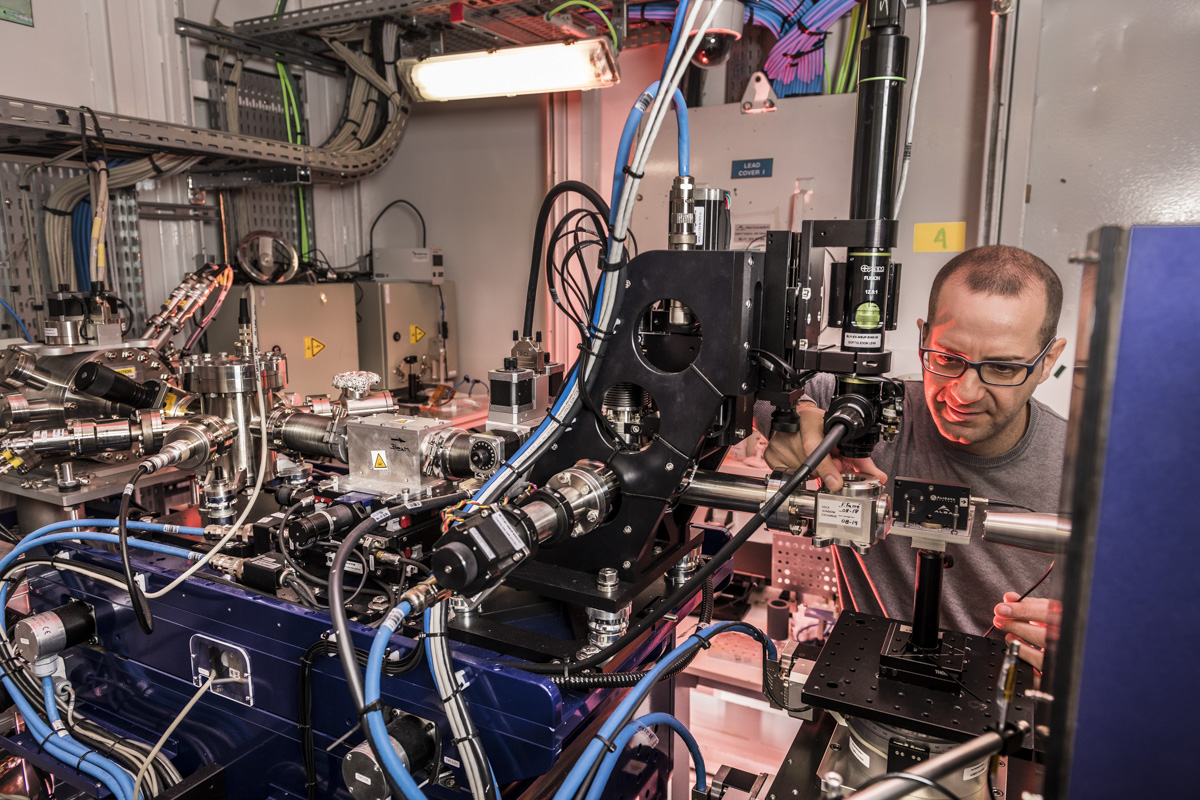
The award-winning study employed a combination of wet chemistry, small angle x-ray scattering (SAXS), and cryo-transmission electron microscopy (cryo-TEM). The SAXS experiments performed at NCD-SWEET beamline were instrumental in characterizing the size, shape and evolution of amorphous C-S-H spheroids during their initial precipitation. The high brilliance of the synchrotron light allowed researchers to monitor these rapid, nanoscale processes in real-time, under controlled solution supersaturation conditions and in the presence of various organic additives like gluconate and hexitols.
Key findings from the paper include the confirmation of a multi-step nucleation pathway for C-S-H and the identification of two distinct precipitation regimes: a classical nucleation regime at lower supersaturation and a spinodal-like nucleation regime at higher supersaturation, where the energy barrier to formation is significantly reduced. In addition, it was reported a significant increase in the kinetic prefactor for C-S-H formation in the presence of organics, correlating with the complexation constants of calcium and silicate with these additives.
"This research provides a much deeper understanding of the very first moments of C-S-H formation," explained Juan Carlos Martínez, beamline scientist at NCD-SWEET. "The capabilities of our beamline were essential for capturing the fast kinetics and nanoscale structural details, especially how organic additives influence this critical phase. These insights are crucial for designing next-generation, high-performance concretes."
The Le Chatelier Medal is a highly esteemed award in the cement and concrete science community, recognizing exceptional contributions to the field. ALBA congratulates all the authors on this prestigious recognition and is proud to have facilitated this significant advancement in cement science.