ALBA Synchrotron

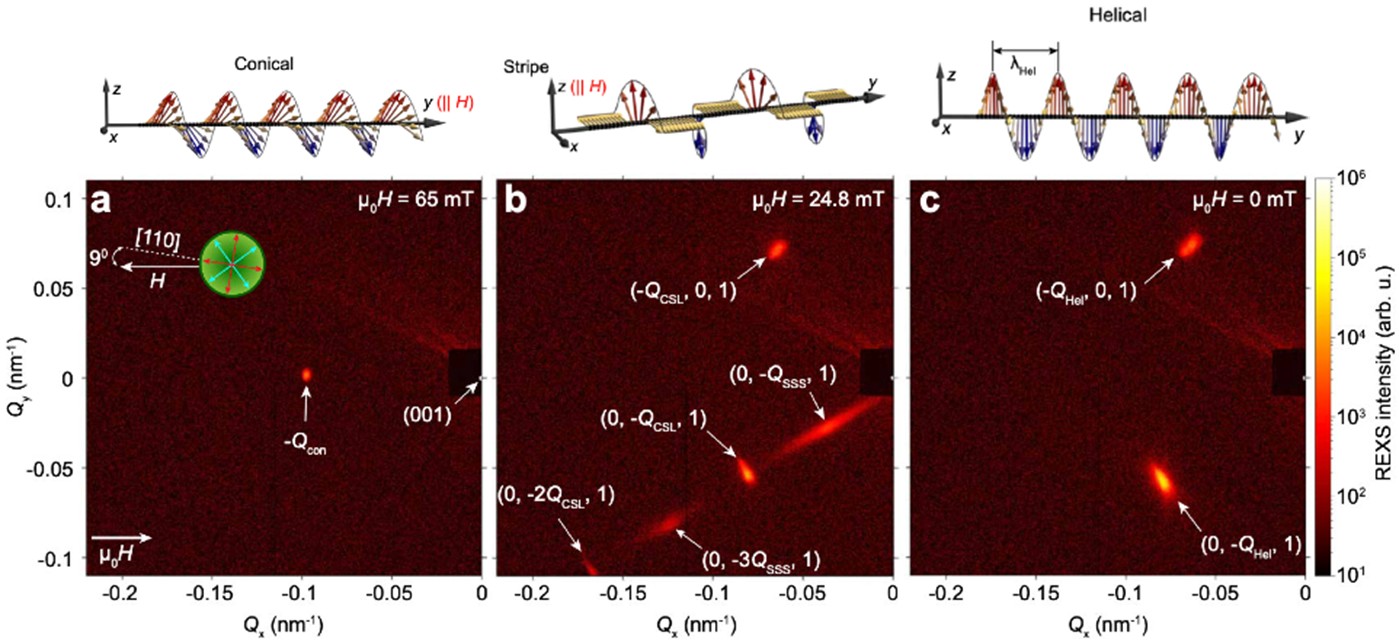
Researchers have uncovered a previously unknown magnetic state confined to the surface of the chiral magnet Cu₂OSeO₃, revealing how surfaces can host spin textures that differ fundamentally from those in the bulk material. The discovery, made using resonant soft X-ray scattering at the ALBA Synchrotron, opens new possibilities for future spintronic technologies.
Magnetism in solid materials originates from tiny atomic "compasses" called electron spins. In many magnetically ordered compounds, these spins simply align parallel or antiparallel to each other. However, in more complex systems they can arrange into intricate patterns in space, forming spin textures, where the direction of magnetization continuously rotates from point to point. Such textures include spirals and topological vortex-like structures (skyrmions), and are currently of great interest because they could be used to store and process information in future energy-efficient technologies.
One important class of materials hosting such states are chiral magnets, where the lack of inversion symmetry leads to a twisting interaction between neighboring spins. In the prototypical cubic chiral compound Cu2OSeO3, this interaction stabilizes a helical spin structure with a well-defined spatial period of 60 nanometers determined by the balance of competing magnetic forces.
In a recent study, an international collaboration including Paul Scherrer Institute (Switzerland), Helmholtz-Zentrum Berlin (Germany) and the ALBA Synchrotron (Spain) has discovered a previously unknown magnetic state localized near the surface of Cu2OSeO3. Using resonant elastic X-ray scattering (REXS) at the BOREAS beamline of ALBA, the researchers discovered a spiral pattern whose period is twice that of the bulk helix, surprising result that reveals how magnetic interactions at the surface can differ markedly from those inside the material.
The experiment highlights the unique capability of resonant soft X-ray scattering to probe magnetism with element specificity and enhanced surface sensitivity. These results demonstrate that surfaces can host distinct magnetic states, opening new opportunities to tailor spin textures by engineering interfaces and thin films.
Beyond fundamental interest, controlling such surface-confined magnetic structures could provide new ways to design functional materials for next-generation spintronic devices, where information is encoded in nanoscale magnetic patterns rather than electric charge.