ALBA Synchrotron

The ALBA Synchrotron has developed a new girder system designed to meet the demanding mechanical stability requirements of ALBA II, the upcoming upgrade of the facility. These girders are key structures that support magnets, vacuum chambers, and diagnostic systems while ensuring their precise alignment along the accelerator.
The prototypes have been developed thanks to the project “Desarrollo de Tecnología avanzada para ALBA II” (Ref.- ALBA01 Next Generation funding (Mecanismo de recuperación y resiliencia)), which supports technological advancements needed for the next generation of the facility.
In particle accelerators, girders are critical mechanical structures that must maintain the position of components with micrometre accuracy, while suppressing drifts and vibrations that could degrade beam quality. Even minimal vibrations or mechanical deviations can affect the trajectory and properties of the electron beam, having a large impact on the photon beam at the beamlines.
These girders must provide an excellent stability against external vibrations and good thermal stability, including high adjustment precision, with acceptable manufacturing costs.
While the current ALBA storage ring operates with 264 magnets distributed in 32 girders, the future machine will integrate 760 magnets in 80 girders within the same circumference, dramatically increasing the density of components, with distance between magnets as small as 10 mm. Such compactness introduces additional constraints like tighter spatial tolerances between components, and reduced margins for alignment errors.
To address these challenges, the new girder system must achieve positioning accuracies on the order of 50 micrometres between adjacent magnets, while maintaining long-term stability despite environmental and structural changes, such as slab deformation or temperature changes.

Upper row shows the current ALBA girder and magnet assembly compared to ALBA II.
Advanced engineering for stability and high precision adjustment
In words of engineer Javier Boyer, who is coordinating the design and validation of this new girder system, "designing the girder system for ALBA II requires balancing two competing requirements: maximum rigidity to suppress vibrations and fine adjustability to enable precise alignment."

Girder showing the plinth, the positioning system and the frame.
As shown at the left, the girder is divided in 3 main parts. The plinth, acting as a support, the positioning system, which consists of the mechanics for the vertical and pitch positioning, and the frame, which is the moving part that supports the full arrangement of magnets, the vacuum system and the diagnostic components.
The new girder incorporates several advanced engineering solutions:
- High-rigidity welded steel structures, optimised to minimise static deformation and increase natural frequencies, ensuring they are well above from the typical 50 Hz vibration range associated with infrastructure systems such as pumps and compressors.
- A multi‑degree‑of‑freedom positioning system allowing controlled adjustment in all six spatial directions (three translations and three rotations).
- Preloaded and locking mechanisms, which enhance structural stability once alignment is achieved.
- Integrated monitoring systems to track positional stability.
The adjustment process follows three main steps:
- The upper frame is attached to the plinth by pre-loaded connections.
- Fine alignment is performed using commercial wedges and push-and-pull fine thread screws.
- Once aligned, the girder remains firmly connected by the pre-loaded unions.
The girders have been designed with a modular approach that offers several advantages such as reduced installation time, improved alignment consistency (as components are pre-integrated) and simplified transport and handling tooling. The modular concept is essential to meet the tight schedule of the ALBA II upgrade while ensuring high precision during installation.
Prototyping and validation under realistic conditions
To validate the design, Nortemecanica, a Spanish company located in Carreño (Asturias) was awarded the contract to build two full scale prototypes. The prototypes were delivered in December 2025 and have undergone extensive testing to assess their mechanical performance and alignment capabilities.
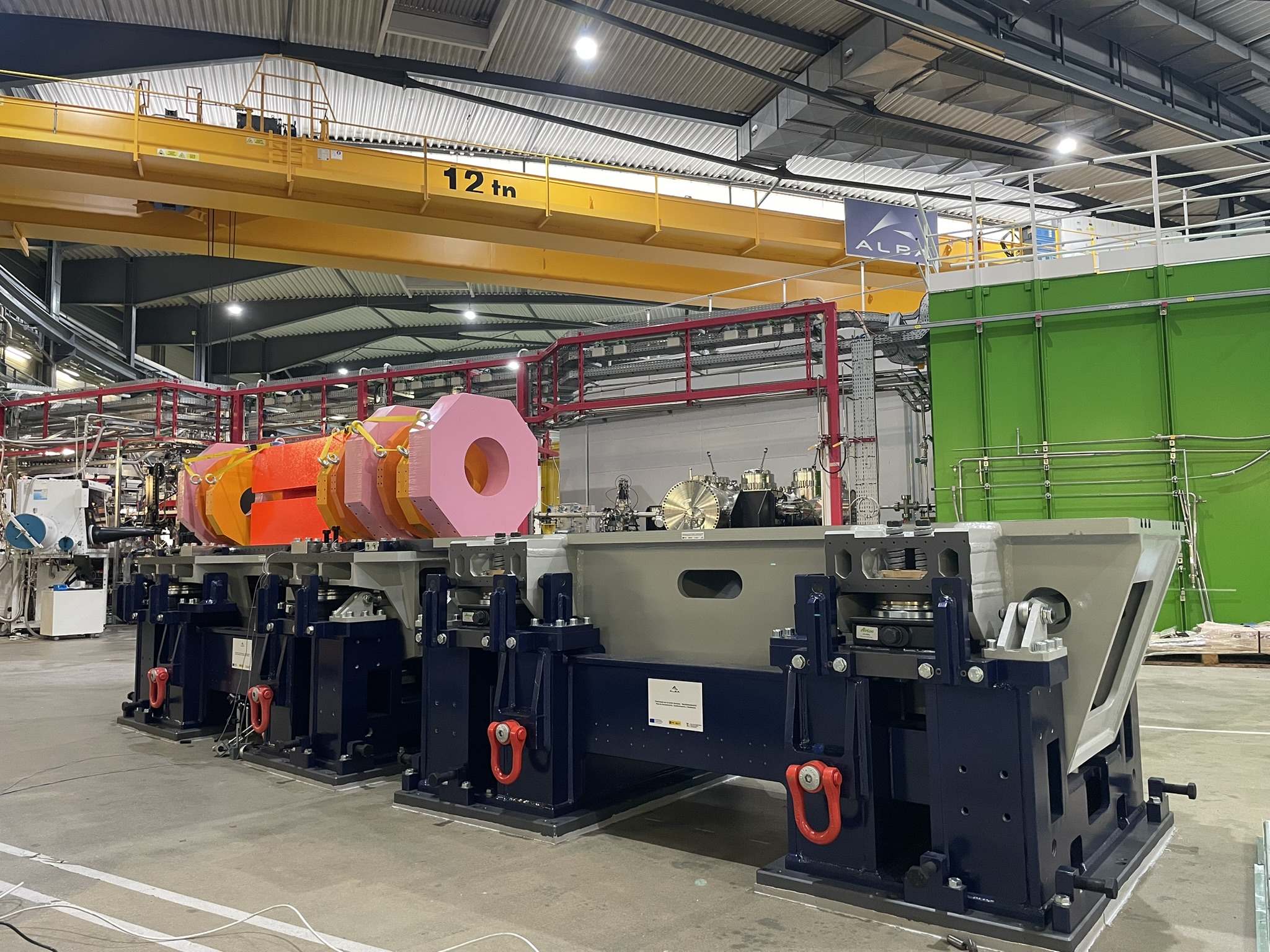
Installed in the ALBA Experimental Hall, the prototypes are evaluated under conditions that closely replicate the operational environment of the accelerator. This allows engineers to analyse vibrational behaviour, structural deformation, and alignment precision before finalising the design for series production.
One of the most critical parameters, that is the planarity of the top surface of the frame, was measured to be 0.06 mm, which is below the specification of 0.10 mm. Javier Boyer declares himself extremely satisfied with the work delivered by Nortemecanica.

The image shows a picture of the completed girder at the manufacturer.

Girder Prototypes installed at the ALBA experimental hall with dummy magnets ready for testing.
Preparing the infrastructure for ALBA II
ALBA II is the upgrade project that will transform the ALBA Synchrotron into a 4th-generation facility, providing even brighter, and more coherent synchrotron light to obtain greater resolution. The project, formally approved in 2025, expects to be ready for users in 2032.
The future ALBA II storage ring will be composed of 760 magnets, mounted on 80 girders conforming a circumference of 268.8m which has a sixteen-fold symmetry. The girders will support the magnets, the vacuum chambers and auxiliary systems throughout the accelerator.
The development of this new girder system is a key step in preparing the infrastructure required for ALBA II. By ensuring extreme mechanical stability and precise alignment, the new girder system will enable the performance gains that define ALBA II.