ALBA Synchrotron

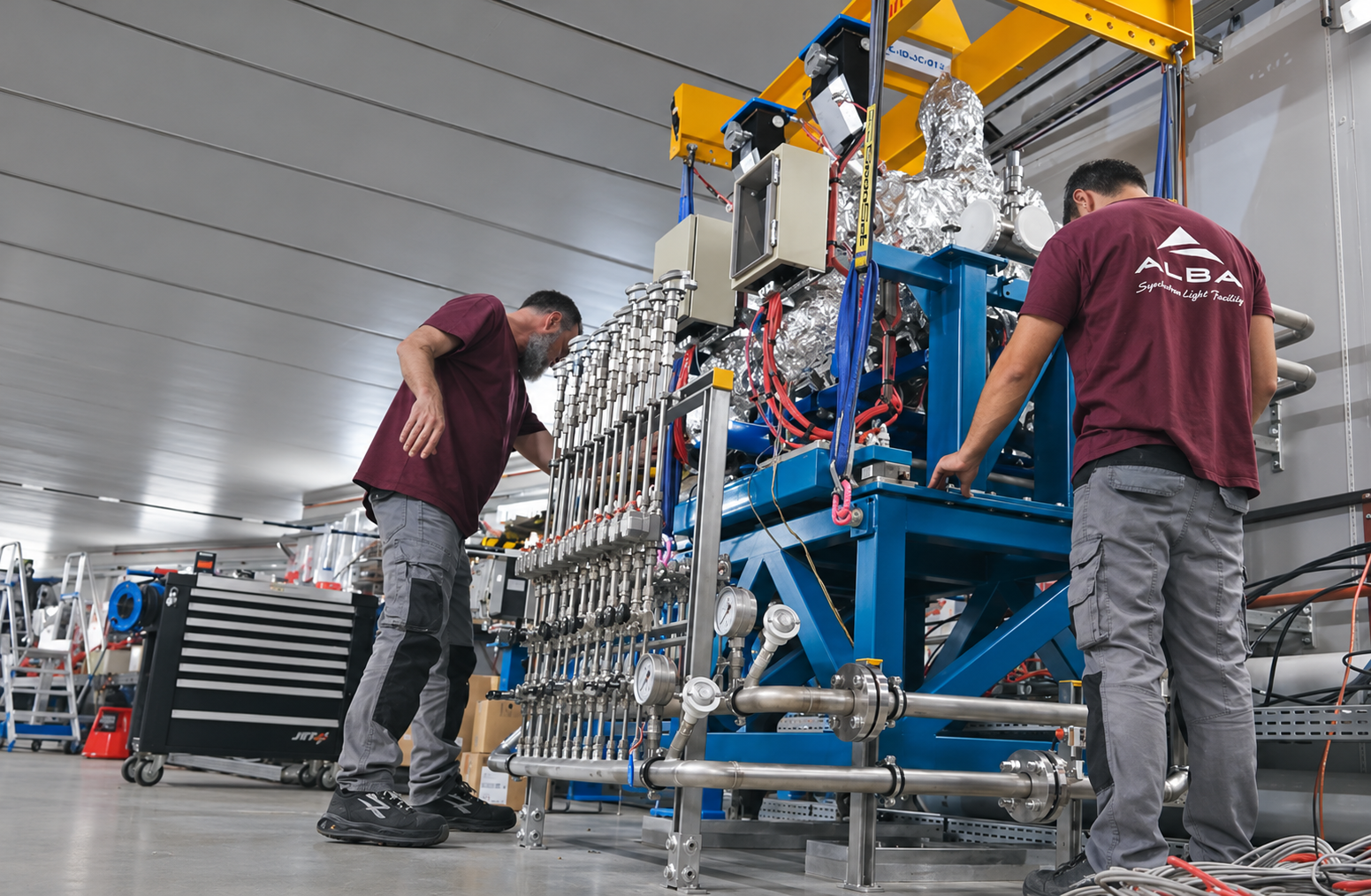
Four new radiofrequency cavities have been installed at the ALBA Synchrotron during the summer shutdown. Designed to improve the stability and lifetime of the electron beam, they represent another important step in preparing the accelerator for its transformation into a fourth-generation light source.
As part of the ALBA II upgrade, four new harmonic radiofrequency (RF) cavities have been installed in the Storage Ring. They are the central components of a new harmonic RF system, which will help improve the performance of the accelerators by increasing the lifetime and stability of the electron beam.
Although primarily designed for ALBA II, the new system will be commissioned and operated in the existing accelerator several years in advance, allowing to gain operational experience before the ALBA II upgrade.
Longer electron bunches for a more stable beam
In a synchrotron, electrons circulate around the Storage Ring in groups known as bunches. As they travel, some electrons collide with one another and may be lost from the beam, gradually reducing its intensity. This phenomenon, known as the Touschek effect, becomes particularly significant in fourth-generation synchrotrons, where electron beams are much more tightly focused.
The new harmonic RF system will help overcome this limitation by making the electron bunches longer. By spreading the same number of electrons over a greater distance, their density decreases, reducing the probability of collisions and electron losses.
The result is a higher beam lifetime, fewer beam variation between injections and more stable operation for users. Longer bunches also reduce the thermal stress in the vacuum chamber components and even improves the transversal emittance, as they reduce the intrabeam scattering. Finally, it helps also to spread the oscillation frequencies of the electrons inside the bunch, thus increasing the longitudinal landau damping and improving the longitudinal stability.
An advanced RF system designed by ALBA
Unlike the passive harmonic cavities used in many synchrotron facilities, ALBA has opted for an active harmonic RF system, which offers greater flexibility and control.
Each cavity will be powered by its own high-power amplifier and equipped with a dedicated low-level radiofrequency (LLRF) control system. This technology will allow the RF voltage and phase to be precisely adjusted, maintaining optimal performance under different operating conditions and compensating for variations that could affect beam stability.
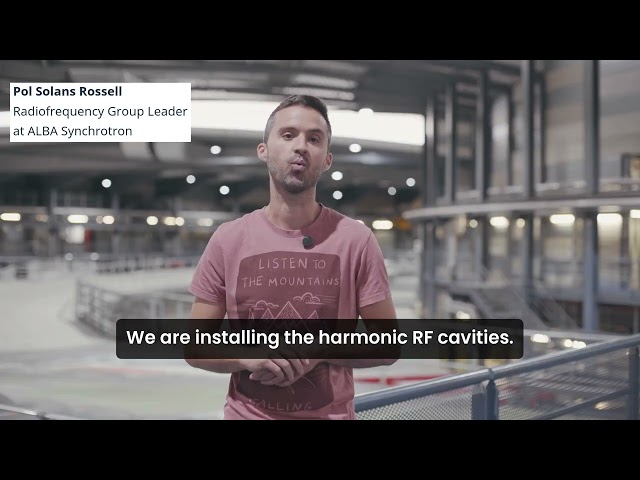
The new system – led by Pol Solans, head of the RF group of the Accelerators division – consists of four normal-conducting cavities operating at 1.5 GHz, installed in pairs in sectors 8 and 12 of the Storage Ring. The cavities were designed by ALBA, and a prototype was successfully tested with stored beam at the BESSY II synchrotron in Berlin (Germany), demonstrating the expected bunch-lengthening performance in both single-bunch and high current multi-bunch operation.
The cavities will be powered by a 20 kW solid-state RF amplifier based on high-efficiency gallium nitride (GaN) technology. A complete waveguide system, including circulators and isolating high power loads, and the LLRF system will complete the harmonic RF system.
Different companies have been involved in the project: Research instruments (Germany) manufactured the cavities, Spinner (Germany) producted the waveguides, Safran-Spain (Spain) developed the Low level RF control system and BTesa Broad Communication (Spain) was in charge of the Solid State Amplifiers.
A new milestone towards ALBA II
ALBA II is the upgrade project that will transform the ALBA Synchrotron into a 4th-generation facility, providing even brighter, more coherent synchrotron light with greater resolution. The project, formally approved in 2025, expects to be ready for users in 2032.
The installation of the new harmonic RF system marks an important achievement for the ALBA teams working on the accelerator upgrade.
Beyond the technological development itself, this project illustrates how ALBA is already preparing for its next generation. By integrating new components into the existing accelerator, the teams will be able to test and refine the technologies that will contribute to the improved performance and reliability of ALBA II.