ALBA Synchrotron

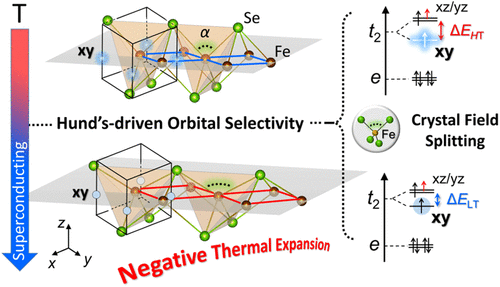
A collaborative research led by FORTH’s QMM Lab in Greece, and with participation of CLÆSS and MSPD beamlines of ALBA, reveals that electron correlations drive coupled electronic and structural instabilities, central to superconducting multiorbital pairing.
In a new series of complementary experiments, scientists from the Institute of Electronic Structure and Laser (IESL) at FORTH — Myrsini Kaitatzi, Alexandros Deltsidis, Izar Capel Berdiell, and Alexandros Lappas — working closely with collaborators from the ALBA Synchrotron (Laura Simonelli, beamline responsible of CLÆSS; and Alexander Missyul, beamline scientist at MSPD), DESY (Martin Etter), and BNL & IPB (Emil S. Bozin), explore a fundamental question at the forefront of condensed matter research: how strong must electron–electron interactions become to raise the temperature at which superconductivity appears?
Using brilliant synchrotron light sources, the researchers uncover previously hidden phases that shed new light on the delicate interplay between electronic orders — a key factor governing the behavior of quantum materials, and especially those where electrons move without resistance.
The team’s work highlights a novel two-dimensional 2D iron-based material designed to conduct electricity without losses, offering promising pathways for energy-efficient systems and next-generation electronics that require less cooling than conventional superconductors.
By combining intercalation chemistry for fine-tuning of material properties, X-ray total scattering for rigorous structural insights, and high-resolution core-level spectroscopies (XAS, XES) providing element-specific and ultrafast (femtosecond) local sensitivity, the researchers detect site-local fluctuations that signal an emerging electron-correlation–driven instability.
As the material cools, this instability manifests as an unconventional negative thermal expansion, arising from complex magnetic interactions. Within the Mott–Hund’s framework — which describes the balance between electron itinerancy and localization — orbital differentiation is shown to moderate electronic correlations and facilitate spin-fluctuation mediated interactions.
Together, these mechanisms open new avenues for designing layered quantum materials in which superconductivity and magnetism can coexist and potentially reach elevated transition temperatures.