ALBA Synchrotron

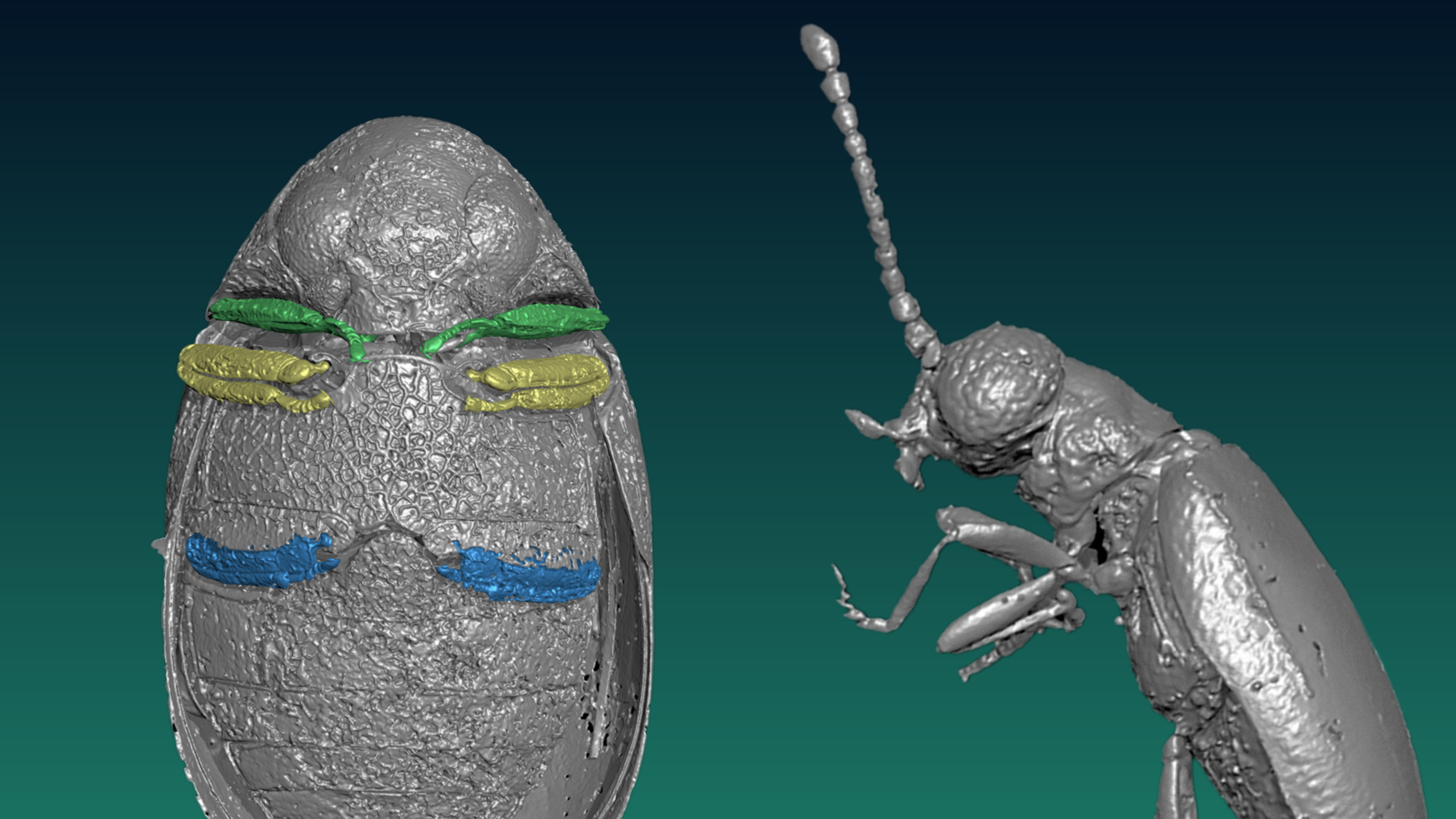
Two studies led by the Institut Botànic de Barcelona (CSIC-CMCNB) and the Facultat de Ciències de la Terra of the Universitat de Barcelona, in collaboration with the ALBA Synchrotron and the Muséum national d’Histoire naturelle in Paris, describe two new fossil species, Imaginedraconium daemon and Cnopus twentyonepilotorum, filling gaps in the beetles’ evolutionary history. Using advanced phase-contrast X-ray imaging techniques, the research teams studied the tiny beetles trapped in Oise (France) amber in 3D without damaging them. The analysis was conducted at ALBA's new FaXToR beamline, inaugurated just over a year ago, revealing anatomical structures completely invisible under a conventional microscope.
Millions of years ago, in a warm, humid forest in what is now France, sticky tree resin trapped tiny traces of life: plants, insects and other organisms. As the resin gradually hardened into amber, it preserved these remains through time. Today, they offer scientists a window into this ancient ecosystem and are helping them identify species never described before.
Two studies led by scientists from the Institut Botànic de Barcelona (CSIC-CMCNB) and the Facultat de Ciències de la Terra of the Universitat de Barcelona, in collaboration with the ALBA Synchrotron and the Muséum national d’Histoire naturelle in Paris, describe two beetle species preserved in amber for around 53 million years: Imaginedraconium daemon, from the Ptinidae family, and Cnopus twentyonepilotorum, from the Aderidae family. The team used synchrotron-based phase-contrast X-ray microtomography at the FaXToR beamline of the ALBA Synchrotron to study the insects’ internal structure without damaging them.
Both species names pay tribute to musical groups for their contributions beyond music: Imagine Dragons for their support of environmental sustainability and climate action, and Twenty One Pilots for raising mental health awareness and reducing stigma around mental health challenges, as the authors explain.
Some beetles play an essential role in forests, decomposing organic matter and returning nutrients to the soil. In the Ptinidae family, many members live in dead wood and other decaying matter, while others are recognised as pests of stored products and cultural heritage. The newly identified species Imaginedraconium daemon belongs to a group of Ptinidae beetles, the “Cryptoramorphini” group, that today lives mainly in tropical and subtropical regions and had no known fossil record until now. This 53-million-year-old fossil shows that the group already existed at that time.
The Aderidae family is made up of tiny, ant-like beetles. The few known larvae develop in decaying wood in the nests of social insects, and the adults are usually found on foliage. Until now, the oldest described fossil species of this family came from 99-million-year-old amber from Myanmar, while the next oldest dated back to around 35 million years ago. Thus, Cnopus twentyonepilotorum helps fill the gap in the fossil record, offering further clues about the family's evolutionary history.
“Both beetles are the first representatives of their respective families to be formally described from Oise amber (France), one of the oldest Cenozoic ambers in Europe, providing new reference points for dating the evolution of these groups” explains Jules Ferreira, corresponding author of this work at the Institut Botànic de Barcelona (CSIC-CMCNB) and the Universitat de Barcelona.
“The Oise amber is a fragile 53-million-year-old time capsule: standard analysis risks destroying the very history we are trying to unlock. The FaXToR beamline completely redefines these boundaries. Synchrotron light grants us a non-destructive super-vision to unwrap the past in 3D, bringing to light microscopic details of these extinct insects that would otherwise remain forever hidden in the dark.” adds Alessandra Patera, group leader of FaXToR at the ALBA Synchrotron.

Dorsal view of Imaginedraconium daemon (left) and Cnopus twentyonepilotorum (right) inside the amber. (A) Left scale bar: 500 μm; (B) Right scale bar: 250 µm.
Looking inside amber without damaging the beetles
An optical microscope can reveal some features of insects trapped in amber, but it does not always show the whole picture. In I. daemon, for instance, the beetle’s underside was hidden from view, yet it is essential for describing the species. To overcome these limitations, the teams combined optical microscopy with X-ray microtomography at the FaXToR beamline of the ALBA Synchrotron. This technique captures thousands of images of the sample from different angles and combines them to create a detailed 3D model of the insect.
The researchers were thus able to study the beetles at micrometre-scale resolution, without altering the amber. They could describe the external structures of both species, including the legs, antennae, palps, thorax and abdomen, and confirm that they were new to science.
These findings highlight just how much the Oise amber still has to reveal. More than 15,000 arthropods have already been recovered from the deposit, yet much of its biodiversity remains to be described. ALBA’s X-ray microtomography offers great potential for exploring this diversity. It reveals fine details that would otherwise remain hidden, without damaging the samples, offering researchers new possibilities for studying fossil species and reconstructing the evolutionary history of beetles.

3D renderings from ALBA Synchrotron X-ray microtomography showing the ventral views of Imaginedraconium daemon (left) and Cnopus twentyonepilotorum (right). Left scale bar: 500 μm; Right scale bar: 250 µm.