ALBA Synchrotron

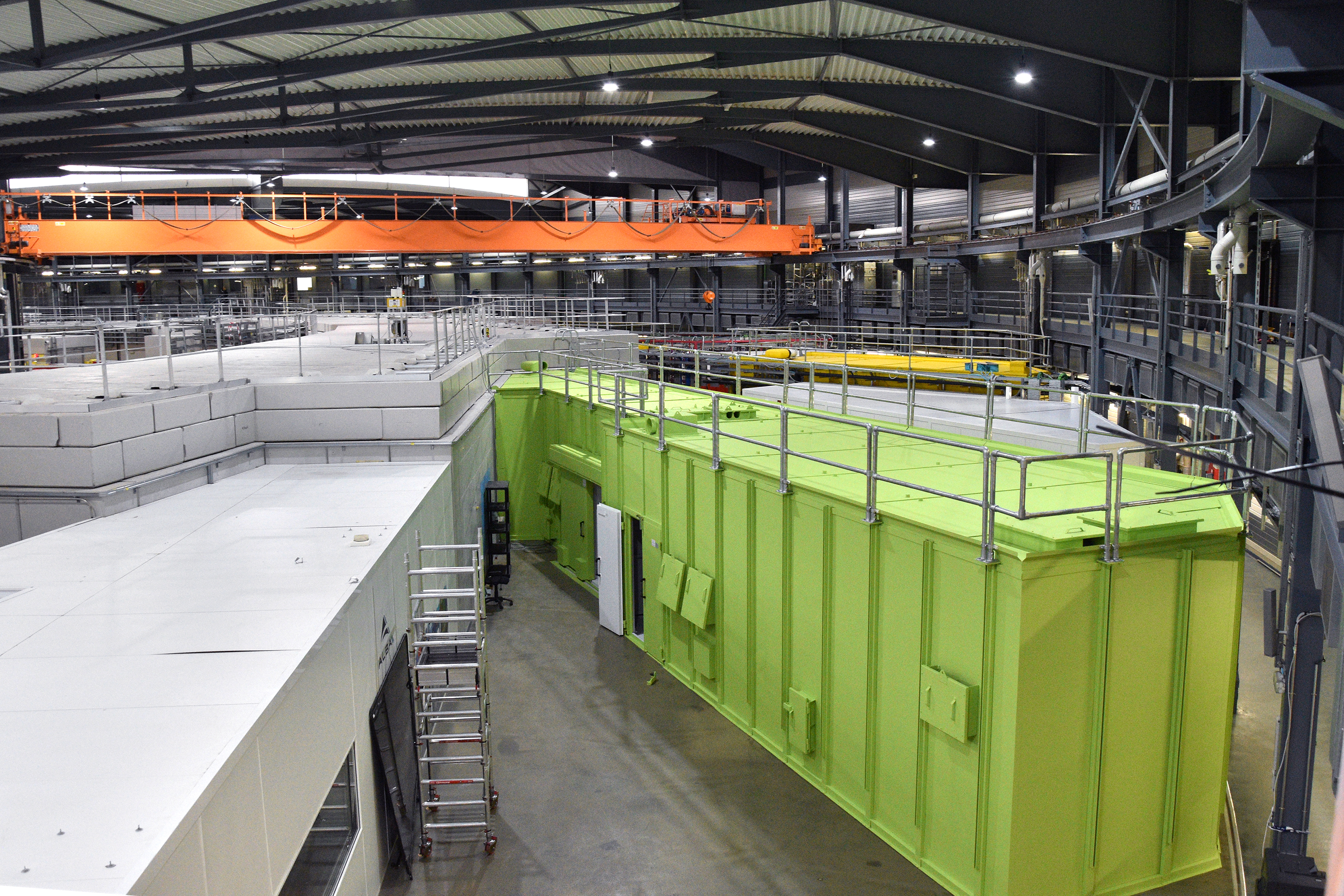
The new MSPD2 beamline will succeed ALBA's current powder diffraction beamline while introducing enhanced capabilities for high-pressure diffraction, microdiffraction and powder diffraction experiments. A new photon source, novel detectors and upgraded instrumentation will support new scientific opportunities for the materials science community.
As part of ALBA II, ALBA is preparing a new generation of scientific instruments for the coming decades. Among them is MSPD2, the successor to the current MSPD beamline, designed to enhance powder diffraction, high-pressure diffraction and microdiffraction experiments.
Operating since 2012, MSPD has become one of ALBA's flagship beamlines, serving users in materials science, chemistry, geology, cultural heritage and energy-related research. Over the years, it has enabled numerous high-impact scientific publications and established itself as a reference beamline in its field.
MSPD will relocate from port 04 to port 33 to make room for CORUS, one of ALBA's future extra-long beamlines. The move will be accompanied by a complete upgrade of the beamline's source, optics and instrumentation.
One of the most significant changes will be replacing the current superconducting wiggler by a state-of-the-art in-vacuum undulator with a period of 15,1mm and covering an energy range from 8 to 40 keV. This new source will provide a brighter and more focused X-ray beam.
For researchers performing high-pressure diffraction experiments, the new beamline will deliver a focused beam smaller than five micrometres at the sample position. This increased precision will allow scientists to study materials under even more extreme conditions inside diamond anvil cells, opening new opportunities in fields such as Earth sciences, condensed matter physics and advanced materials research.
Microdiffraction experiments will also benefit from the smaller beam size, providing improved spatial resolution and enabling research in complex and heterogeneous materials with greater detail.
The high-pressure and microdiffraction station will be equipped with a new generation single-photon-counting detector, replacing the current CCD-based system. The upgrade will provide faster data acquisition, improved sensitivity and higher-quality measurements.
The powder diffraction station will also incorporate new detector technologies and advanced high-angular-resolution detection schemes.
The new optical design will also provide greater flexibility for experiments at lower X-ray energies, further expanding the beamline's scientific reach.
The project also incorporates a sustainable approach by reusing and refurbishing selected components from the existing beamline whenever possible. Elements such as filters, slits, windows, cryogenic equipment and parts of the experimental stations will be integrated into the new beamline.
"Although MSPD2 will preserve valuable expertise and several existing components, the combination of a new photon source, upgraded optics and new instrumentation effectively makes it a new beamline," explains the Alexander Missiul, project manager for MSPD2 and beamline scientist at MSPD.
Progress towards 2029
The construction of MSPD2 is already underway. The radiation shielding hutch for the new beamline has been completed at the end of 2025, marking an important milestone in the project. These works have been developed thanks to project "Desarrollo de Tecnología avanzada para ALBA II" (Ref. ALBA01 Next Generation funding - Mecanismo de Recuperación y Resiliencia), which supports technological advancements needed for the next generation of the facility.
Throughout 2026, activities will focus on the installation of beamline infrastructure and the procurement and design of the new high-pressure experimental station.
The goal is to have the new MSPD2 fully operational in early 2029, ready to serve the scientific community as one of the key beamlines of the ALBA II era.