ALBA Synchrotron

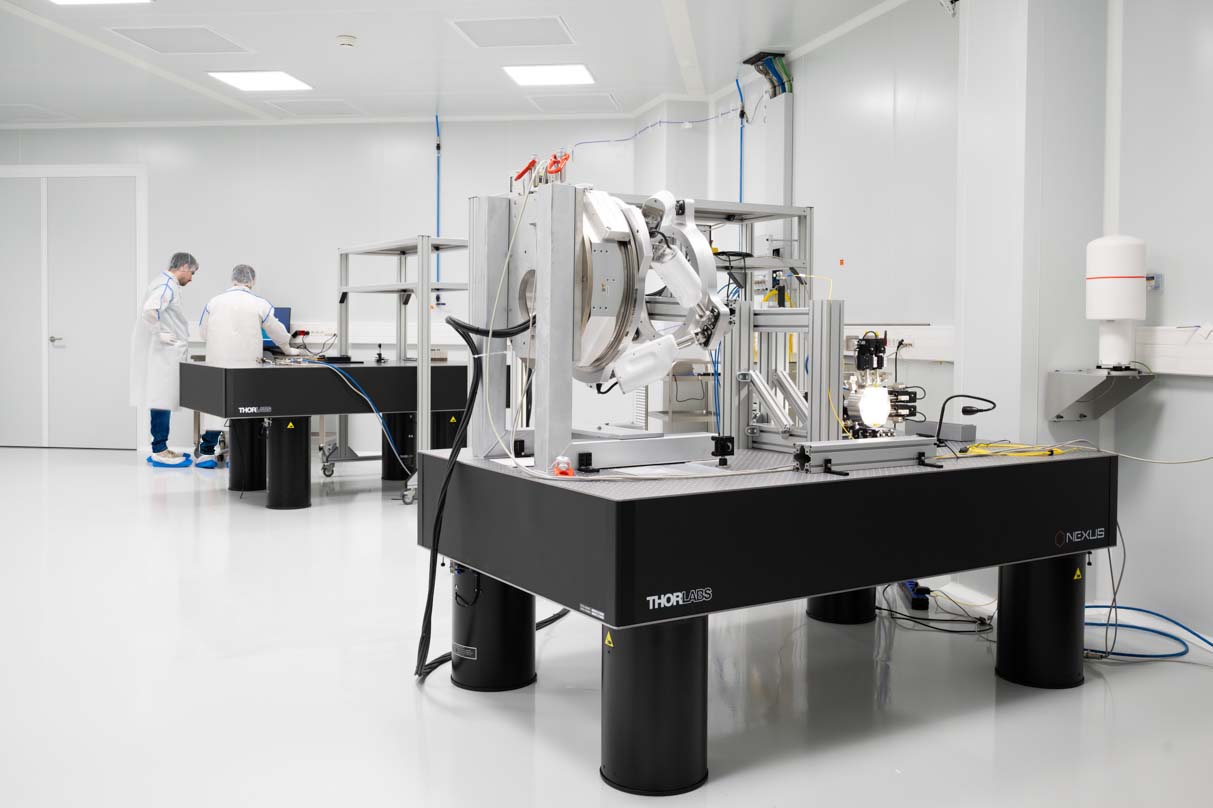
The ALBA Synchrotron has opened a new laboratory to develop nanomotion and nanopositioning technologies, aimed at creating and testing ultra-precise systems for current and future beamline components, particularly in preparation for the ALBA II upgrade.
The laboratory has been developed thanks to the project "Desarrollo de Tecnología avanzada para ALBA II" (Ref. ALBA01 Next Generation funding - Mecanismo de Recuperación y Resiliencia), which supports technological advancements needed for the next generation of the facility.
Many experiments at synchrotron light sources rely on positioning samples and optical components with nanometre-scale accuracy. Achieving this level of stability is essential in techniques such as X-ray microscopy, diffraction, and nanoprobes, where the X-ray beam can be only a few micrometres -or even nanometres- wide.
The new Nanomotion laboratory at ALBA provides a controlled environment for the development, assembly and testing of high-precision mechatronic systems, ensuring that the experiments instrumentation meets the demanding positioning requirements of modern synchrotron experiments.
The laboratory enables the development of instrumentation for faster, and more precise data collection, by improving the motion control, and synchronization among beamline components, aiming at better scientific results. Its activities include mechatronics design, motion metrology, motion control optimization, prototype testing, and early commissioning of instrumentation.
The laboratory also enables research in precision mechatronics, including new control algorithms, synchronization systems, and feedback technologies based on interferometers and other sensors.
Beyond synchrotron instrumentation, this type of technological development is also relevant for industrial innovation, as the same precision engineering concepts can be transferred to sectors such as advanced manufacturing, optics, or semiconductor technologies.
The Nanomotion laboratory is run by Nilson Bernardo Pereira and Juan Luis Frieiro Castro, members of the Interdisciplinary and Multimodal section of the Experiments division.
A clean room designed for nanometre-level stability
The Nanomotion laboratory has been built as a cleanroom of 100m2 and located directly on the main slab of the ALBA's experimental hall, which provides excellent thermal and mechanical stability. The laboratory is divided in three areas: a clean room workspace, a "super quiet" room for extremely sensitive measurements, and a control room for assembly, testing and remote control of projects in the clean room.
The laboratory maintains strict environmental stability, including controlled temperature, humidity, air flow and particle levels. High-efficiency HEPA filters remove 99.995% of particles larger than 0.3 micrometres, while a network of sensors continuously monitors temperature, humidity, and vibrations.
The "super quiet" room provides an even more stable environment by reducing acoustic noise and other external disturbances. Its temperature is stable within ±0.01ºC. These conditions are crucial for testing systems, interferometric feedback sensors and precision motion stages, which require extremely stable environments to reach their full performance.
Preparing the technologies for ALBA II
ALBA II is the upgrade project that will transform the ALBA Synchrotron into a 4th-generation facility, providing even brighter, more coherent synchrotron light with greater resolution. The project, formally approved in 2025, expects to be ready for users in 2032.
The creation of the Nanomotion laboratory is an important step in preparing the technological infrastructure for ALBA II as it provides unprecedented levels of mechanical stability and positioning precision which are required for future nanoprobes extra-long beamlines.
By developing and validating these technologies today, the new laboratory ensures that ALBA's instrumentation will be ready to take full advantage of the capabilities of ALBA II.